

Engineering & design decisions
Personalized ergonomics, a flat carbon structure, bought shifters where they beat DIY, and honest limits on what the published prototype proves.
Why build it
I wanted a Formula-style steering wheel with grips shaped for my hands and controls where my thumbs could reach them without changing grip during a race. Commercial options were expensive; building it myself was the point.
The project combines mechanical design, material selection, simplified structural simulation, 3D scanning, CNC manufacturing, electronics, embedded firmware, and practical testing. Some parts were custom; others were purchased when that gave a better result.
Key decisions
Condensed from the full GitHub engineering case study.
Personalized ergonomics
Modeling-clay hand impressions → iPhone 3D scanning → CAD cleanup → iterative 3D prints and button-reach tests. Fit to my hands, not a generic commercial grip.
Flat CNC carbon plate
Steel, aluminum, and carbon were compared. A flat CNC-cut carbon-fiber structural plate limited rotating mass for force-feedback response while staying affordable as a 2D cut — without laminating a composite part myself.
Shifters: print, then buy
Custom printed magnetic paddles were prototyped first. Later revisions integrated Fanatec shifter mechanisms after weighing tactile feel against CNC cost and complexity.
Electronics as a prototype
Two Arduino-based controllers, a USB hub, switches/encoders, repurposed LED strip, and a supported display. Extended use exposed vibration-related connection weak points — motivating a future integrated PCB that does not yet exist in the published design.
Software reuse
Arduino firmware was written for the wheel and display; SimHub templates and interfaces were reused instead of rebuilding an entire telemetry stack.
About the 20 Nm figure
Early design assumed a future direct-drive upgrade, so the plate was assessed in a simplified Fusion 360 model with an approximate 20 Nm torque case at the central mount. That was a preliminary feasibility check — not validated laminate data, not full grip geometry, and not physical load or fatigue testing. Twenty newton-metres is a simulation/design target, not a guaranteed safe torque rating. The wheel was later used with a direct-drive wheelbase in roughly the 10 Nm class.
V1 and V2 in brief
Earlier previews show V1 with printed shifter paddles and V2 with integrated Fanatec shifter hardware. Photographs span development stages; color changes alone do not establish chronology.
If development resumes
- Custom PCB for fewer connectors and better vibration robustness
- Improved printability, grip finishing, and component integration
- Possible silicone-overlaid grips and higher-quality tactile buttons
- VR-focused revision: emphasize robust inputs; likely omit display and LED shift lights
- Accurate parts/revision mapping, bill of materials, and assembly instructions
Experimenting with the files
Requirements and hard limitations for anyone cloning the repo.
- FDM 3D printer or printing service
- Suitable machining or cutting of the carbon-fiber components
- Basic electronics knowledge and soldering skills
- Compatible microcontrollers, buttons, rotaries, display, and firmware
- Compatible wheelbase mount and hardware
- Time for adaptation, troubleshooting, and mechanical/electrical verification
- Not plug-and-play — no complete assembly guide or verified revision-to-file map.
- Parts may need manual adjustments; firmware has not been comprehensively tested for third-party builds.
- Some published files come from different development stages.
- The proposed integrated PCB has not been developed for the published design.
Prototype gallery
Curated photographs from development. Full gallery and silent demo clips live on GitHub.
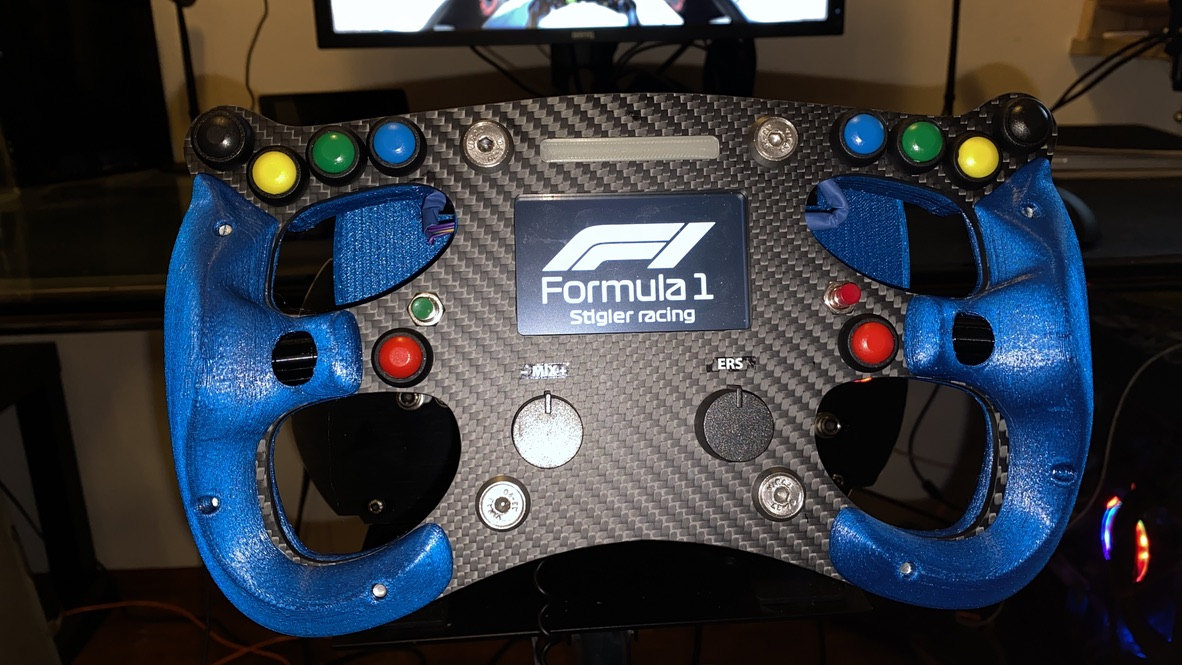
Assembled prototype with carbon front plate and blue grips. 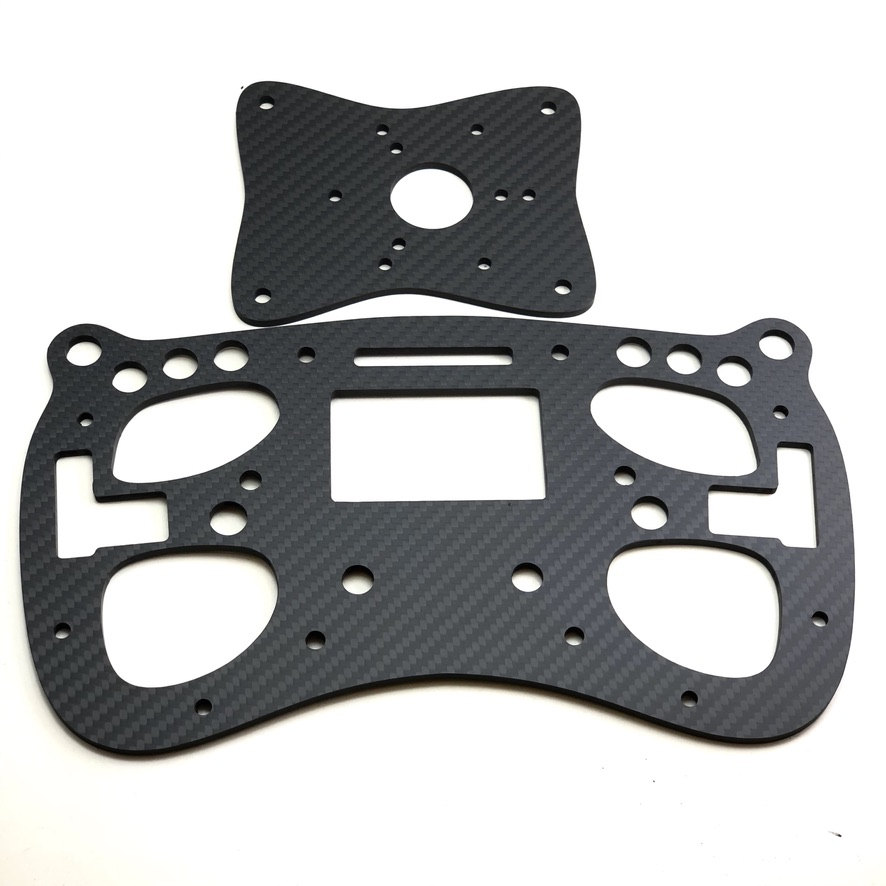
CNC-machined carbon-fiber structural plates. 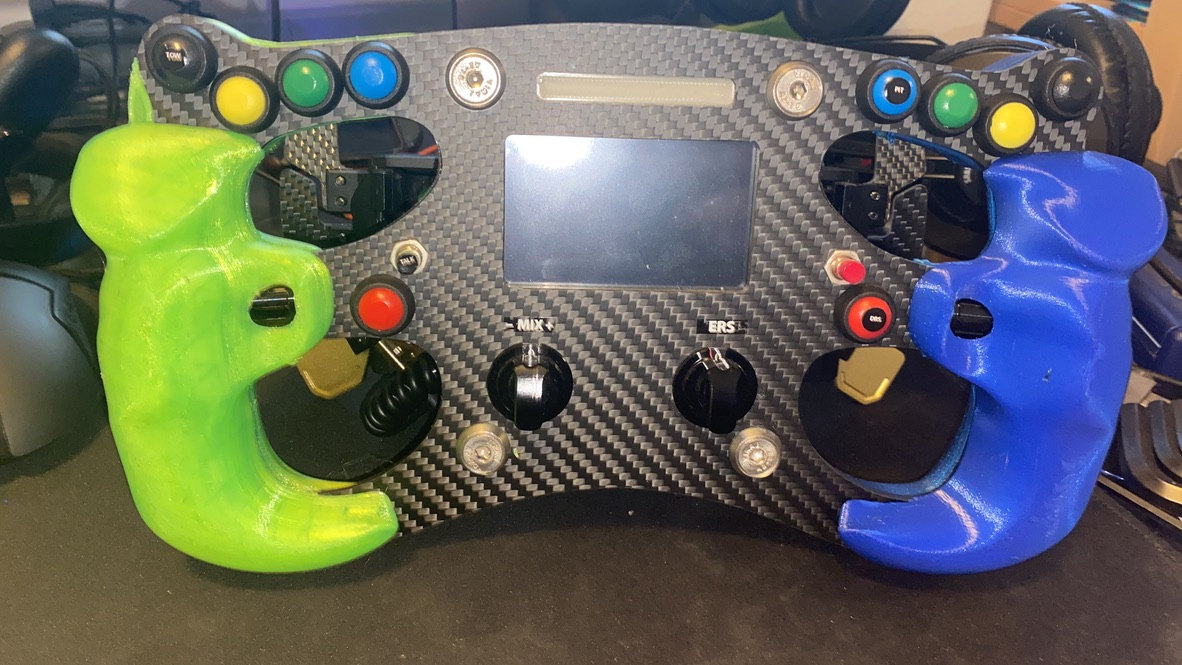
Printed grip variants used to evaluate comfort and reach. 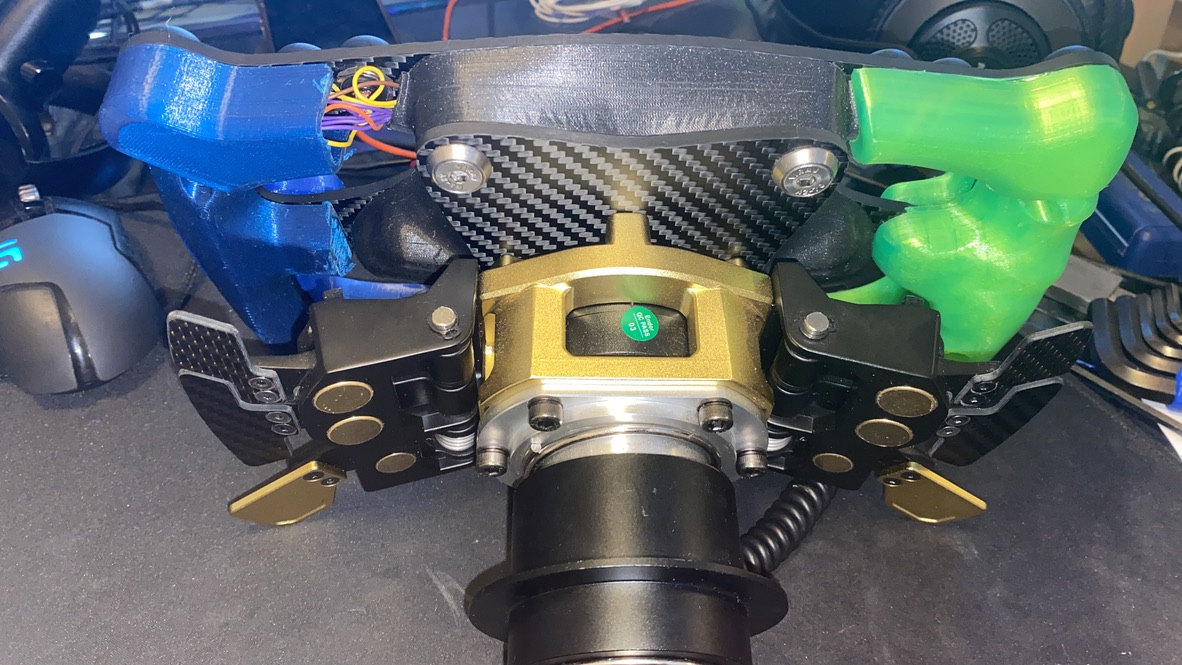
Rear assembly with purchased shifter mechanisms. 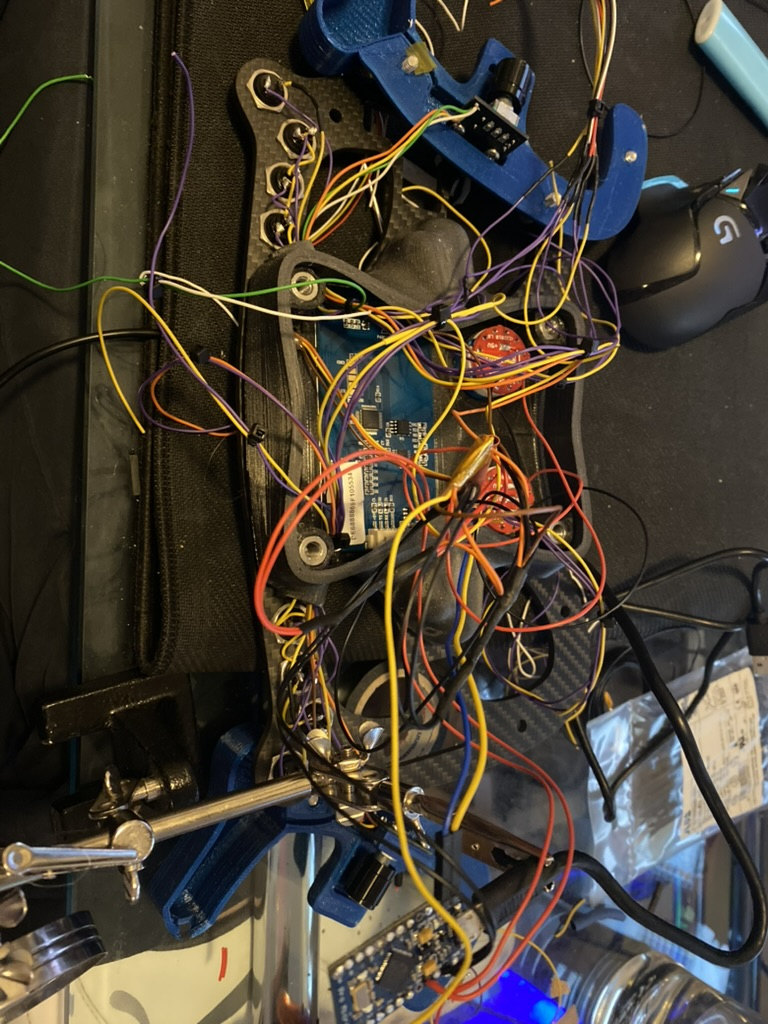
Open electronics prototype — vibration later exposed weak connections. 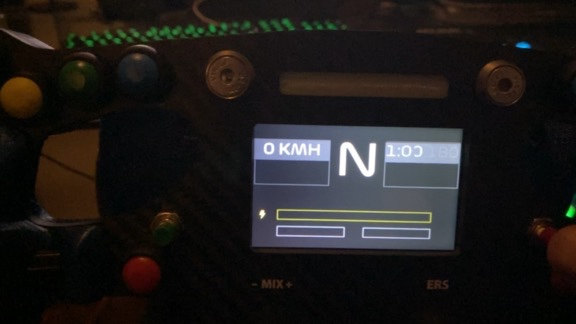
Touchscreen SimHub telemetry dashboard.
Go deeper
This page summarizes decisions for builders and search. The full case study, costs, and additional images are on GitHub.
Open repositoryFull engineering case studyWorking prototype videoBack to overview